Roof heating cables use a lot of electricity if they run all winter and a modest amount if they run only in freeze-thaw weather. The cost is watts times hours times your rate per kilowatt-hour. A 30 m (100 ft) cable labelled 5 watts per foot draws about 500 watts, so each hour it runs uses half a kilowatt-hour.
Do roof heating cables use a lot of electricity?
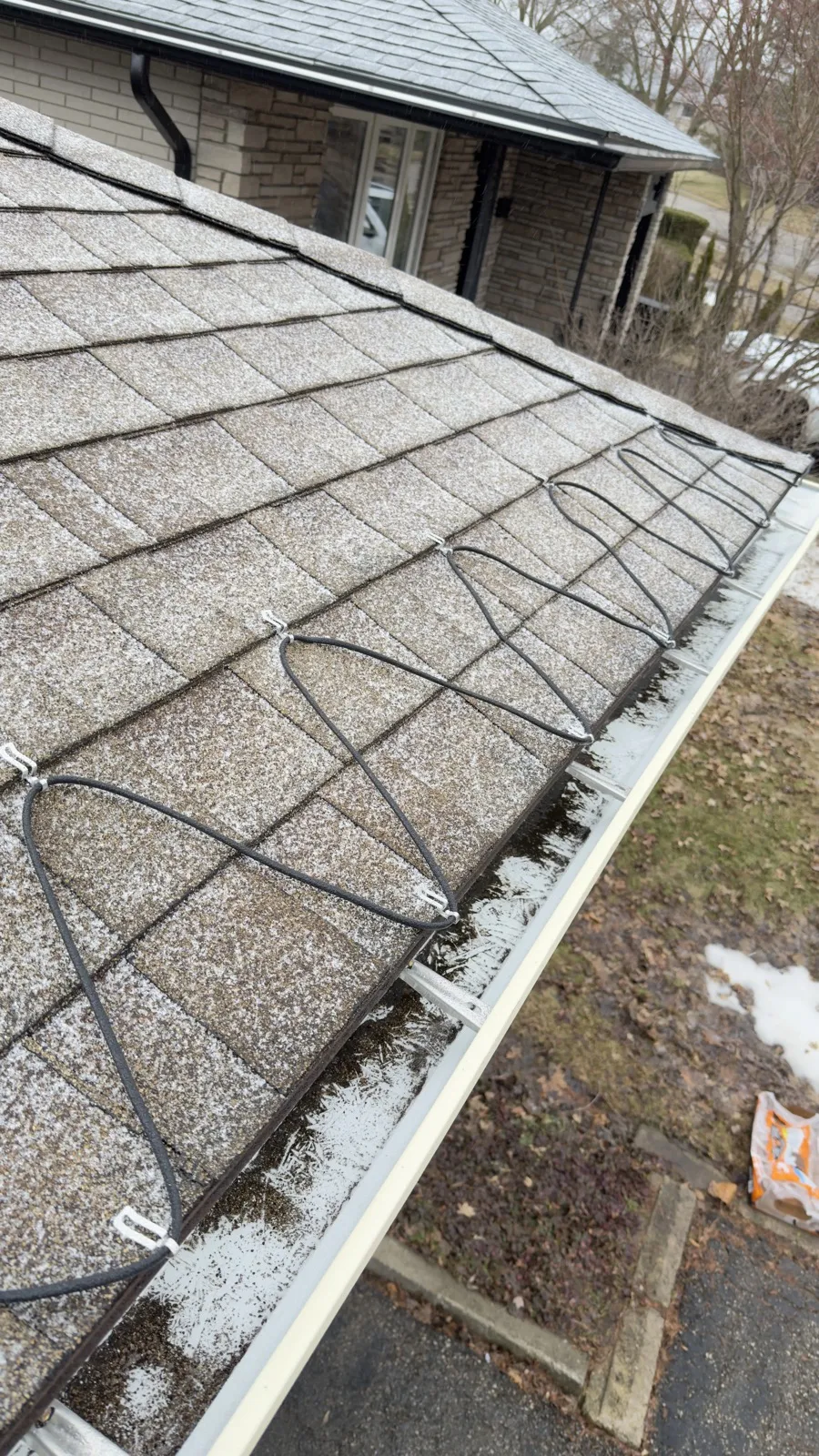
A roof heating cable is an electric resistance heater. What it costs depends on two numbers: how many watts it draws and how many hours it runs. Natural Resources Canada says electric heating cables use a significant amount of electrical energy, and that is true when they are left on without need.
For scale, a portable electric heater is commonly rated up to 1,500 W. A cable system of 1,000 W is in the same league. You would not leave a portable heater running day and night, and the same restraint applies to cable.
The good news is that cable only has to run when there is cold weather and meltwater. Managed well, the hours are a small share of the winter.
How to estimate what heat tape costs to run
You need four steps and a bill.
- Find the watts. Multiply the cable length in feet by its watts per foot, or read the total watts printed on a fixed-length kit.
- Convert to kilowatts. Divide the watts by 1,000.
- Multiply by hours. Kilowatts times hours of running gives kilowatt-hours (kWh), the unit on your bill.
- Multiply by your rate. Take your price per kWh from your latest bill and multiply.
Step four varies by household. Ontario households are on a time-of-use plan, an ultra-low overnight plan, a tiered plan or a retailer contract, and regulated rates are updated once a year. Your bill shows which plan you are on, so use that rate instead of a guess.
Where to find your cable's wattage
The wattage is on the box, the cable's tag or the product sheet. Fixed-length kits usually give a total in watts. Cut-to-length cable gives watts per foot. Labels on roof cable commonly run from about 5 to 12 W/ft, so do not assume a number.
Self-regulating cable needs one extra note. Its output is rated at a stated reference temperature and changes with temperature: it rises as the cable gets colder and falls as it warms. The label figure is a good starting point, not an exact reading for every hour of a storm.
Length matters as much as watts per foot. A longer cable draws more power, which is why measuring correctly pays off. Heating only the eaves that ice up keeps the total down.
A worked example: one cable through a winter month
Take 60 m (200 ft) of cable at 5 W/ft. That is 1,000 W, or 1 kW. Now compare three ways of running it over a 30-day month. The hours are scenarios to show the effect, not a forecast, and your winter will decide the real number.
| How it is run | Hours in the month | Energy used |
|---|---|---|
| Sensor control, starting only in cold, wet conditions | 40 | 40 kWh |
| Manual switch, on through storms and the melt after | 100 | 100 kWh |
| Left on around the clock | 720 | 720 kWh |
Multiply each figure by your rate per kWh to get a cost. The last row uses 18 times the energy of the first. That ratio is why running time decides the bill more than the cable does. Compare the kWh figures with the monthly total on your own bill to see what share a cable would add.
How controls and rate plans change the bill
Controls cut hours. A temperature plus moisture sensor is built to start the cable only when it is cold and wet and to stop when conditions end. A thermostat alone runs it through dry cold. A timer runs it on a schedule whatever the weather. A manual switch is as good as your memory.
Rate plans change what each hour costs. On a time-of-use or ultra-low overnight plan, a kWh costs different amounts at different hours of the day. On a tiered plan, heavy winter use can push you into the higher tier for part of the month. Neither plan changes the energy the cable uses. Both change what you pay for it.
Self-regulating cable lowers its output as it warms, so it draws less on a mild thaw than on a hard freeze. That helps, but it still draws some power whenever it is energized.
Is the electricity worth it?
That depends on what the cable protects. A cable on one eave that drips onto the front steps, or on a downspout that freezes solid every year, may earn its power. A cable run along an entire roof edge to cover a problem that attic insulation would end is harder to justify.
Natural Resources Canada says sealing attic air leaks and insulating thoroughly is the preferred fix for ice dams, because it keeps house heat out of the attic and the roof cold. Do that first where you can. Our post on attic insulation and ice dams explains how. Cable then handles the spots that still ice up.
Ways to cut the running cost
- Heat only the trouble spots. North-facing eaves, the edge above an entry and downspouts that freeze are the usual candidates.
- Fit a sensor control. It is the most direct way to shorten run time.
- Keep eavestroughs and downspouts clean. Water that drains freely leaves less to refreeze, so the cable has less to do.
- Switch off in spring. Do not leave a plug-in cable powered through summer.
- Check your usage data. If your utility's online account shows hourly use, compare a cold night with the cable on and a similar night with it off.
- Size it right. More cable than the layout needs draws more power for no gain.
D&D Snow Services quotes roof and gutter heating cable by measuring the eaves, eavestroughs and downspouts on site. Running cost depends on cable length and how long it runs, and any hardwiring is electrical work for a Licensed Electrical Contractor.
Heating cable electricity questions
How much electricity does roof heat cable use?
Multiply cable length by watts per foot, divide by 1,000, then multiply by hours of running. A 30 m (100 ft) cable at 5 W/ft uses 0.5 kWh per hour. Over 100 hours that is 50 kWh. Your cost is that figure times your rate per kWh.
Is heat tape expensive to run?
It depends on the hours. A cable controlled by a moisture and temperature sensor runs only in cold, wet weather and uses little. The same cable left on all winter uses a great deal more. Cable length also matters, so heating only the problem eaves keeps the bill down.
Do self-regulating cables use less power?
They cut their own output as they warm, so on a mild day they draw less than a cable that always gives full output. They draw more when cold, and they still use some power whenever energized. A control that switches them off between storms saves the most.
Does heat tape use a lot of electricity when left plugged in over summer?
It should not be left powered then. A powered cable keeps drawing some power, wastes it in warm weather, and your manual may warn against it. Switch it off and unplug it in spring once nights stay above freezing, and check the cable before using it again in fall.
Ready for a Reliable Winter Season?
D&D Snow Services covers Kitchener, Waterloo, Cambridge, Guelph and surrounding region.
Get a Free Snow QuoteKey Takeaways
- Running cost is watts times hours times your rate per kWh. Hours matter far more than the cable.
- Read the wattage on the cable's label. Roof cable labels commonly run from about 5 to 12 W/ft.
- A 30 m (100 ft) cable at 5 W/ft uses 0.5 kWh each hour it runs. Left on all month, it adds up fast.
- A temperature plus moisture sensor, heating only the trouble eaves and switching off in spring all cut the bill.
- Sealing attic air leaks and insulating comes first. Cable handles the spots that still ice up.
Sources & References
Request snow-service details
Identify the clearing areas, access priorities and seasonal or per-visit needs.
Prefer to send the details first? Request a quote or call (519) 501-5003.