Eavestrough heating cable is needed only where a frozen gutter or downspout traps meltwater. That usually means north-facing eaves, long runs, flat-pitched sections and downspouts that freeze solid. Cable along the roof edge alone can leave water with nowhere to go, so a working system gives meltwater a clear path from the roof edge, through the eavestrough and down the downspout to a safe outlet.
Is eavestrough heating cable worth it for your home?
For many homes, no. If the attic is well sealed and insulated, the eavestroughs are clean and the downspouts drain freely, snow usually melts and leaves without help. Cable earns its place at specific trouble spots where ice keeps forming despite those basics.
It helps to know what cable does and does not do. It does not melt the snow on the whole roof. It keeps a drainage path open so meltwater can leave the roof before it refreezes into an ice dam or a fringe of icicles. Natural Resources Canada confirms that heating cables melt channels in the ice. It also notes they use a significant amount of electricity, and its main advice for ice dams is to seal attic air leaks and insulate, which is why those jobs come first.
You will see the same product sold as heated gutter cables, rain gutter heat cable, gutter heaters and heat tape for gutters. These are all names for electric heating cable run along the roof edge, through the eavestrough and down the downspout. If your gutters ice up every year, our post on eavestrough ice buildup in Ontario helps you work out why.
Why cable on the roof edge alone is not enough
Think of the drainage route as a chain: roof edge, eavestrough, downspout, outlet. Ice anywhere in the chain stops the water, and the water then backs up the way it came.
Cable at the roof edge cuts a channel through the snow and ice so meltwater can reach the gutter. If the eavestrough below is full of solid ice, though, that water has no place to go. It spills over, freezes along the edge and builds ice back up toward the shingles. The same thing happens if the downspout is frozen. The outlet at the bottom is a common place for a plug of ice to form, especially where water pools or drains onto cold ground.
That is why a complete system adds cable inside the eavestrough, along the trough to the downspout, and down the full length of the downspout. Ice that freezes solid inside a downspout can also stress its seams. Our post on frozen downspouts in Ontario and how to prevent them explains the downspout side in more detail.
If the freeze-up problem is only at the roof edge, cable along the edge may be enough. If water pours over a full gutter, or the downspout never runs in January, the drainage channel needs heat too.
Which Ontario homes benefit most
| Trouble spot | Why it freezes | What cable in the gutter does |
|---|---|---|
| North-facing eaves | Little direct sun, so the edge stays below freezing while other sides thaw | Keeps the trough open when the sun does not |
| Long, unbroken runs | A lot of meltwater and a long way to the downspout, so one frozen stretch blocks everything | Carries water the full length to the outlet |
| Flat-pitched sections such as porch roofs, dormers and additions | Water drains slowly and snow sits longer | Gives slow water a channel before it refreezes |
| Downspouts on shaded walls and inside corners | The pipe stays cold and freezes solid | Keeps the vertical run and outlet open |
| Downspouts that drain across a walkway or driveway | Water spreads out and refreezes as a slick patch | Helps it leave the pipe, but only if it is also directed away |
| Roofs where more attic insulation is hard to add | Vaulted ceilings and tight roof spaces leave the heat loss in place | Manages the symptom while other fixes are planned |
Two further points. First, cable works with a good attic, not instead of one. Second, if only one or two eaves are a problem, treat those eaves and leave the rest. There is no need to heat every gutter on the house.
Downspout heating cable and where the water goes
Heated downspouts only solve the problem if the water has a safe place to land. Before you add cable, check where each downspout discharges:
- Water should leave the downspout and run away from the foundation, not pool beside it. An extension or splash pad that slopes away does this.
- It should not drain across a walkway, steps or driveway, where it refreezes into ice you then have to treat.
- If a downspout connects to an underground drain, ask the installer how the cable should end, and check with your municipality before changing where any downspout discharges.
The eavestrough itself must be ready too. Cable cannot work in a trough packed with leaves, so clean the gutters and downspouts in the fall. Look for sags where water pools instead of draining toward the downspout.
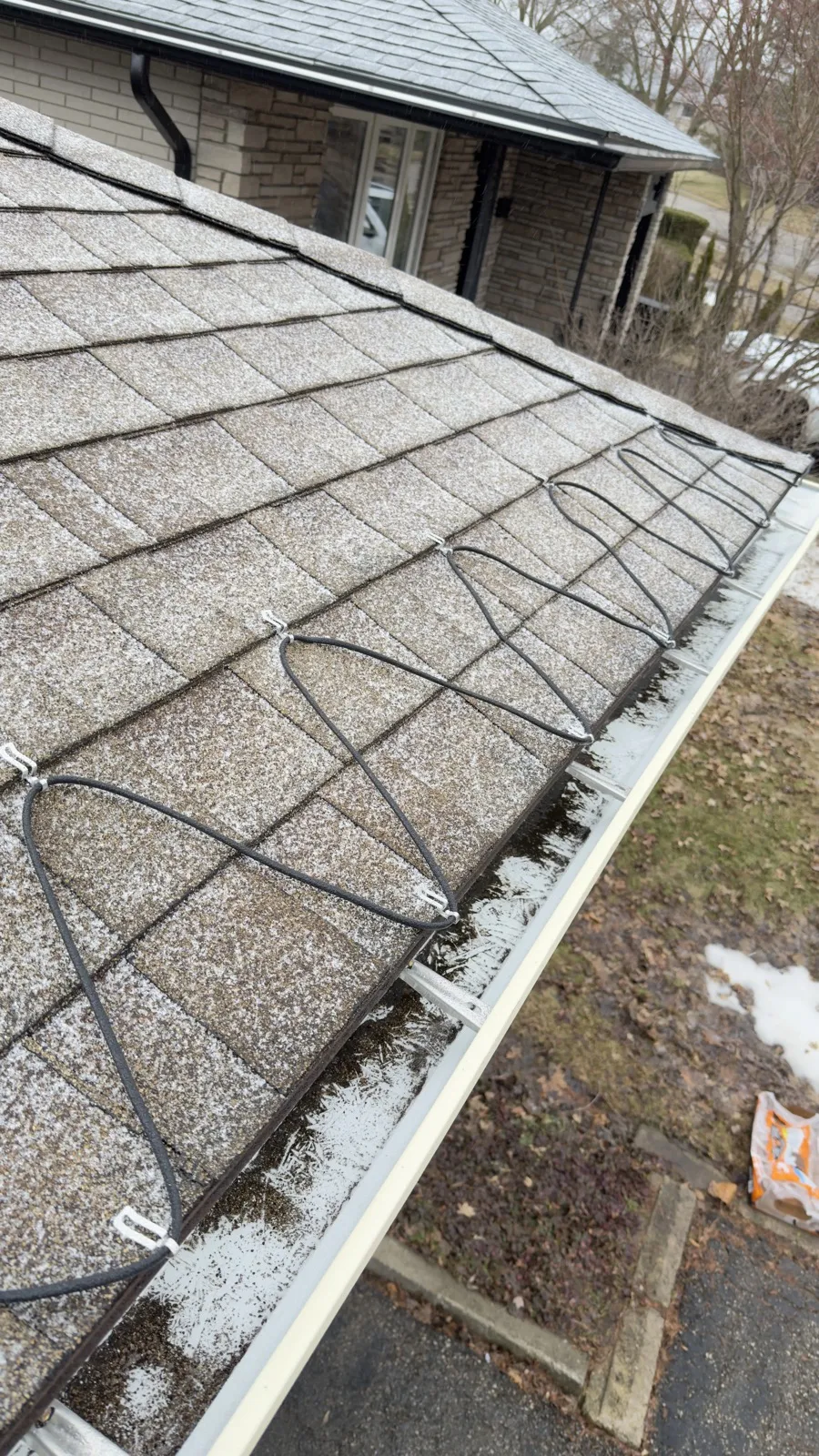
When people search for downspout heating cable installation, they usually mean this layout: cable laid in the bottom of the trough and secured with clips, then fed down through the downspout and out past the outlet. How much cable you need depends on the run lengths and the number of downspouts, and the manufacturer's instructions govern spacing and fixing. Self-regulating cable adjusts its heat output to the temperature, so it works harder when it is colder.
Power, safety and running cost
Heating cable is an electrical product used outdoors, so power matters. A plug-in system uses a protected exterior outlet. The Electrical Safety Authority recommends ground fault circuit interrupters (GFCIs) on outdoor outlets and advises hiring a Licensed Electrical Contractor for permanent outdoor wiring. A dedicated circuit, hardwiring and controls are electrical work that a Licensed Electrical Contractor does under ESA rules. Ask any installer to state in the estimate who is doing the electrical part.
Operating habits affect the bill. Switch the system on before a storm, and turn it off in spring. Running cost depends on the length of cable and how many hours it runs, so ask what controls come with the system. The less time it runs without need, the lower the cost. Natural Resources Canada reminds homeowners that cable consumes a significant amount of power, which is one more reason to place it only where it earns its keep.
Finally, installation happens at the roof edge. Ladders and icy ground do not mix, so leave winter installation and repairs to trained crews.
Cheaper fixes first, and when to call a pro
Work through this order before spending on cable:
- Clean the eavestroughs and downspouts in the fall.
- Fix sagging runs so water flows to the downspout.
- Extend downspouts so water lands away from the house and off walkways.
- Rake snow off the lower roof after heavy snowfalls, from the ground.
- Seal attic air leaks and add insulation where you can.
If ice still traps water at certain eaves or downspouts after that, cable is a reasonable next step. D&D Snow Services installs roof and gutter heating cable in a zigzag along the roof edge and through eavestroughs and downspouts, with the estimate setting out who handles the electrical work. If you want more on how cable fits into ice dam control, our post on roof heating cables for ice dam prevention in Ontario goes into it, and gutter ice dam prevention for Ontario homes covers the wider picture.
Gutter heating cable questions
Do heated gutter cables stop ice dams?
Not on their own. Cable keeps a drainage path open so meltwater can leave the roof, which makes ice dams and icicles less likely. It does not remove the cause, which is attic heat reaching the roof deck. Pair cable with air sealing, insulation and ventilation for a lasting fix.
Do I need heating cable in the downspout as well as the gutter?
If the downspout freezes solid, yes. Cable in the trough alone just sends meltwater to a blocked pipe. Downspouts on shaded walls and those with long vertical runs freeze most often. Cable should run the full length and past the outlet so the exit does not plug with ice.
Can I install gutter heat tape myself?
Plug-in kits exist, and manufacturer instructions must be followed exactly. Use a GFCI-protected outdoor outlet. Hardwiring, a dedicated circuit and controls are work for a Licensed Electrical Contractor under ESA rules. Working at the roof edge on a ladder is a fall risk, so many homeowners hire a crew.
When should I turn heating cable on and off?
Turn it on before a storm or a freeze-thaw stretch, once snow is on the roof or ice is forming, and turn it off in spring when the roof edge stays clear. Running it all winter wastes power. Ask your installer which controls are fitted and how they work.
Ready for a Reliable Winter Season?
D&D Snow Services covers Kitchener, Waterloo, Cambridge, Guelph and surrounding region.
Get a Free Snow QuoteKey Takeaways
- Eavestrough heating cable is worth adding only where ice repeatedly traps meltwater, not as a default for every gutter.
- Cable at the roof edge needs a clear path through the eavestrough and downspout, or the water backs up anyway.
- North-facing eaves, long runs, flat-pitched sections and shaded downspouts benefit most.
- Direct downspout water away from the foundation and off walkways, and clean gutters in the fall first.
- Hardwired and dedicated-circuit work belongs to a Licensed Electrical Contractor under ESA rules.
Sources & References
Request snow-service details
Identify the clearing areas, access priorities and seasonal or per-visit needs.
Prefer to send the details first? Request a quote or call (519) 501-5003.