How much roof heating cable you need depends on four measurements: the length of the eave, the depth of the overhang, the eavestrough run and the height of each downspout. Multiply the eave length by the maker's loop factor, then add the eavestrough, the downspouts and a little extra for connections. The total always lands well beyond the eave length, so measure before you buy.
How much roof heating cable you need: the parts that add up
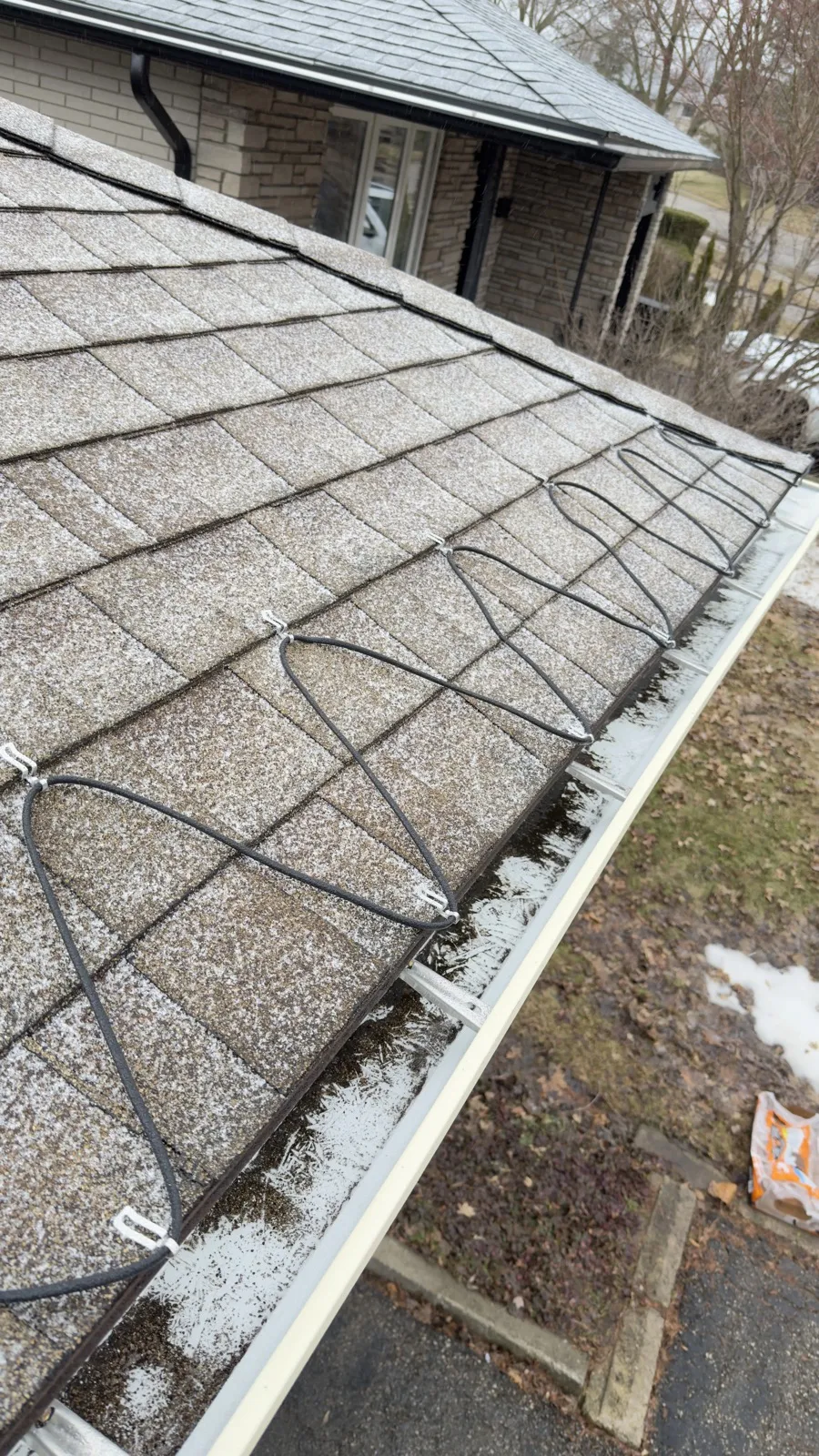
Roof heating cable is not laid in a straight line. It zigzags up and down the lower roof, runs along the bottom of the eavestrough and drops down each downspout. That is why the length you need is always larger than the eave. Count five parts.
- The zigzag on the roof edge. Eave length multiplied by a loop factor from the cable maker's table. The factor rises as the overhang gets deeper, because the loops have to climb higher up the roof.
- The drop into the eavestrough. Some methods add half the eave length for the cable that bridges the roof edge and the eavestrough.
- The eavestrough run. About one length of cable for each length of eavestrough. A wide eavestrough can take two runs.
- The downspouts. The height of each downspout plus about 0.3 m (1 ft) at the outlet. A downspout in the middle of a run needs cable down and back up, so count it twice.
- Extras. Each power connection, splice and end seal uses up a little cable, and valleys and dormers add more.
Some makers fold the eavestrough run into the loop factor and others list it separately. Pick one maker's method and follow it from start to finish. Mixing methods is how people count the same eavestrough twice.
How to measure for roof heating cable
You can do the whole job from the ground with a tape, a notebook and your phone camera. Do not walk on a frosty or snowy roof to measure it.
- Sketch each roof edge that drains to an eavestrough. Treat each roof section as its own measurement. The main house, an addition and a porch roof often have different overhangs.
- Measure each eave length along the eavestrough. Measure only the sections that need cable, not the whole perimeter.
- Find the overhang. Stand under the outer edge of the roof and measure back to the wall. This is the number the loop factor depends on.
- Measure each downspout from the eavestrough outlet to the ground. Note whether it sits at the end of a run or in the middle, and where it drains: a splash block, an extension or an underground pipe.
- Count valleys, dormers and skylights. Every spot where a roof meets a wall or another roof holds ice and needs its own cable allowance.
- Mark the nearest outdoor outlet. The cable's own cord is short, so the power point decides where the cable starts.
Take photos of each eave. They help when you compare the layout with a contractor or check it against the maker's diagram. Cable is still sold by the foot at most Ontario hardware stores, so write down both metric and imperial figures.
A worked example with sample numbers
Take a house with one 12 m (40 ft) eave and two downspouts, each 3.7 m (12 ft) tall. One downspout sits at the end of the cable run and one sits mid-run. Here is the arithmetic.
| Part | How it is counted | Length |
|---|---|---|
| Zigzag on the roof edge | 12 m (40 ft) times a loop factor of 3.0 | 36 m (120 ft) |
| Drop to the eavestrough | 12 m (40 ft) times 0.5 | 6 m (20 ft) |
| Eavestrough run | One length per length | 12 m (40 ft) |
| End-of-run downspout | 3.7 m (12 ft) plus 0.3 m (1 ft) | 4 m (13 ft) |
| Mid-run downspout | 3.7 m (12 ft), down and back up | 7.3 m (24 ft) |
| Connections | Power end and end seal | 0.6 m (2 ft) |
| Total | About 66 m (219 ft) |
The loop factor of 3.0 is a round number for the example. Your factor comes from the maker's table for your overhang and roof type. Those tables differ. For a 30 cm (12 in) overhang, one published table gives 2.8 ft of cable per foot of eave and another gives 4.0, because loop height and cable type are not the same. That gap is the reason to use the instructions that come with the cable you are buying, not a generic calculator.
Round up to the next standard length, or order cut-to-length cable if the product is made to be cut. Never cut cable that is not made to be cut. Surplus normally goes into a valley or a downspout run rather than a coil, so check the manual.
How overhang, roof pitch and Ontario snow change the layout
Overhang sets the formula. A deep overhang is a long stretch of roof with no heat from the house beneath it, so meltwater from the warm part of the roof refreezes there. Loops have to reach back up past the wall line to give that water a path. A shallow overhang needs shorter loops and less cable.
Roof type changes the factor and the clips. Tables for metal seam roofs are not the same as tables for shingles, and not every cable is approved for every roofing material. Check the label before you buy.
Pitch and snow decide how the cable survives. Heavy wet snow and lake-effect squalls load the cable and its clips. On a steep metal roof, snow can slide off in one sheet and tear cable away. In that case snow guards above the cable protect it as well as the people and plants below.
Valleys and dormers are where makers disagree. One maker allows about 1.8 m (6 ft) for each valley. Another has you run cable two-thirds of the way up and down the valley. Neither is wrong, but you must follow the method for your product.
You may not need the whole edge. North-facing eaves, shaded porches, and the eaves above an entry are the usual trouble spots. If the south side never ices, you can leave it out and cut both the cable and the power it draws.
Check the circuit load before you order
Length decides load. Watts equal cable length times watts per foot, and amps equal watts divided by 120 volts. A cable labelled at 5 W/ft (some are higher or lower) would draw about 1,100 W on the 66 m (219 ft) example, which is roughly 9 A at 120 V. That is a first check only.
The maker's table gives the maximum length per breaker size, and it can be shorter than simple arithmetic suggests. Self-regulating cable draws more current when it is cold, so its limits allow for that. A long run may have to be split into two cables on separate circuits.
Power also decides who does what. A plug-in system uses a protected exterior outlet. A dedicated circuit, hardwiring and controls are electrical work for a Licensed Electrical Contractor under ESA rules, and the ESA advises hiring one for permanent outdoor wiring. Natural Resources Canada also points out that heating cables use a significant amount of electrical energy, which is one more reason to size the system to the problem eaves.
Why an on-site measure beats an online calculator
Online calculators are fine for a rough number. They cannot see the things that change the layout: a second-storey eave you cannot reach with a tape, a roof section with a deeper overhang, a gap in the eavestroughs, a downspout that ties into an underground drain, or the roofing the clips must attach to. Some makers advise running cable in a downspout that ties into an underground drain down below the frost line, which no calculator will ask about.
Getting it wrong costs you either way. Too short leaves gaps where ice forms. Too long overloads the circuit or wastes power.
D&D Snow Services measures eaves, eavestroughs and downspouts on site and gives a free written estimate for roof and gutter heating cable. The estimate states who handles the electrical part. If you want to understand how cable fits with the other ways of stopping ice, our post on roof heating cables for ice dam prevention covers it.
Roof heating cable sizing questions
How many feet of roof heat cable do I need?
There is no single figure. The example above shows the method: a 12 m (40 ft) eave with two downspouts comes out near 66 m (219 ft) using a sample loop factor. Your total changes with overhang, valleys, dormers and downspout heights, so follow the maker's table for your cable.
Can I cut roof heating cable to length?
Only if the product is made to be cut. Some self-regulating cable is cut to length and finished with an approved end kit. Pre-assembled cable usually must not be cut, and cutting it can void the warranty and create a hazard. Read the label and manual before you touch it.
Do I need cable along the whole roof edge?
Not always. Cable only has to give meltwater a path where ice keeps forming. North-facing eaves, shaded sections and the edges above entries are common trouble spots. Heating a short, well-chosen run costs less to buy and less to run than the full perimeter.
Should I order extra cable?
Order the next standard length up, not a large surplus. Leftover cable cannot simply be coiled on the roof. Makers normally say where extra length may go, such as an extra downspout run or valley. Too much cable also adds load to the circuit.
Ready for a Reliable Winter Season?
D&D Snow Services covers Kitchener, Waterloo, Cambridge, Guelph and surrounding region.
Get a Free Snow QuoteKey Takeaways
- Total cable length is the zigzag on the roof edge, plus the eavestrough run, the downspouts and small allowances for connections.
- Measure from the ground: eave length, overhang depth, downspout height, valleys, dormers and the nearest outdoor outlet.
- Use one maker's method and loop factor from start to finish, because published tables for the same overhang differ.
- Check circuit load before ordering. Dedicated circuits, hardwiring and controls are work for a Licensed Electrical Contractor.
- Heat only the eaves that ice up. A shorter run costs less to buy and to run.
Sources & References
Request snow-service details
Identify the clearing areas, access priorities and seasonal or per-visit needs.
Prefer to send the details first? Request a quote or call (519) 501-5003.