Best choice for most Ontario homes: a self-regulating roof heat cable. It adjusts its heat along its length to the temperature, can usually be cut to fit, and some makers allow it to cross itself where constant-wattage cable never can. Constant-wattage cable still suits long, simple runs of known length. Here is how the two types compare and how to choose for your eave.
How self-regulating and constant-wattage cable work
Both types are electric cables that keep a drainage path open for meltwater along the roof edge, through the eavestrough and down the downspout. They differ in how they make heat.
Constant-wattage cable uses resistance wire. It gives the same output per length whenever it is powered, whether the air is -20°C or +2°C. Some constant-wattage cable is made in one fixed length, finished at the factory and impossible to shorten. Other versions can be cut at marked intervals. The label tells you which you have.
Self-regulating cable has a conductive core between two parallel wires. As the cable warms, the core carries less current and the output falls. As it cools, output rises. Every short stretch of cable responds to its own temperature, so a section buried in snow puts out more heat than a section lying in a sunny, dry patch. Much of this cable can be cut to length on site and finished with the maker's end kit, but check the product, because not all of it can.
Neither type melts a whole roof. Both are meant to keep a channel open, and the National Research Council Canada notes in an archived building digest that ice should never be allowed to form in the channels, because the cable may not clear a large ice dam once it has formed.
Self-regulating vs constant wattage, side by side
| Question | Self-regulating | Constant wattage |
|---|---|---|
| Heat output | Rises in the cold and falls as it warms, point by point | Fixed for the whole length while powered |
| Crossing or touching itself | Some makers allow crossing; read the manual first | Must not touch or cross; heat builds up at the overlap |
| Cutting to length | Often cut on site with an end kit, if the product allows | Fixed-length versions cannot be cut |
| Cold-start electrical load | Draws more current when cold, so circuit limits are lower | Steady draw |
| Control needed | Yes. A sensor or thermostat still saves energy | Yes. It has no way to ease off by itself |
| Good fit | Valleys, dormers, mixed runs, gutters and downspouts | Straight, simple runs of known length |
The right-hand column is why self-regulating cable is the usual pick for roofs with a lot of turns. Constant-wattage cable demands a layout that is planned to the centimetre. Self-regulating cable forgives more mistakes, but it does not forgive damage, water in a connection or an overloaded circuit.
The overlap rule: what makes cable fail
Overlap is the layout problem that most often decides which cable you can use. The National Research Council Canada's building digest warns that if cables become twisted and overlap, the insulation can melt at the overlap and cause a short circuit. That is written about cable in general, and it applies with the most force to constant-wattage cable, which cannot ease off where two runs touch.
Practical rules that follow:
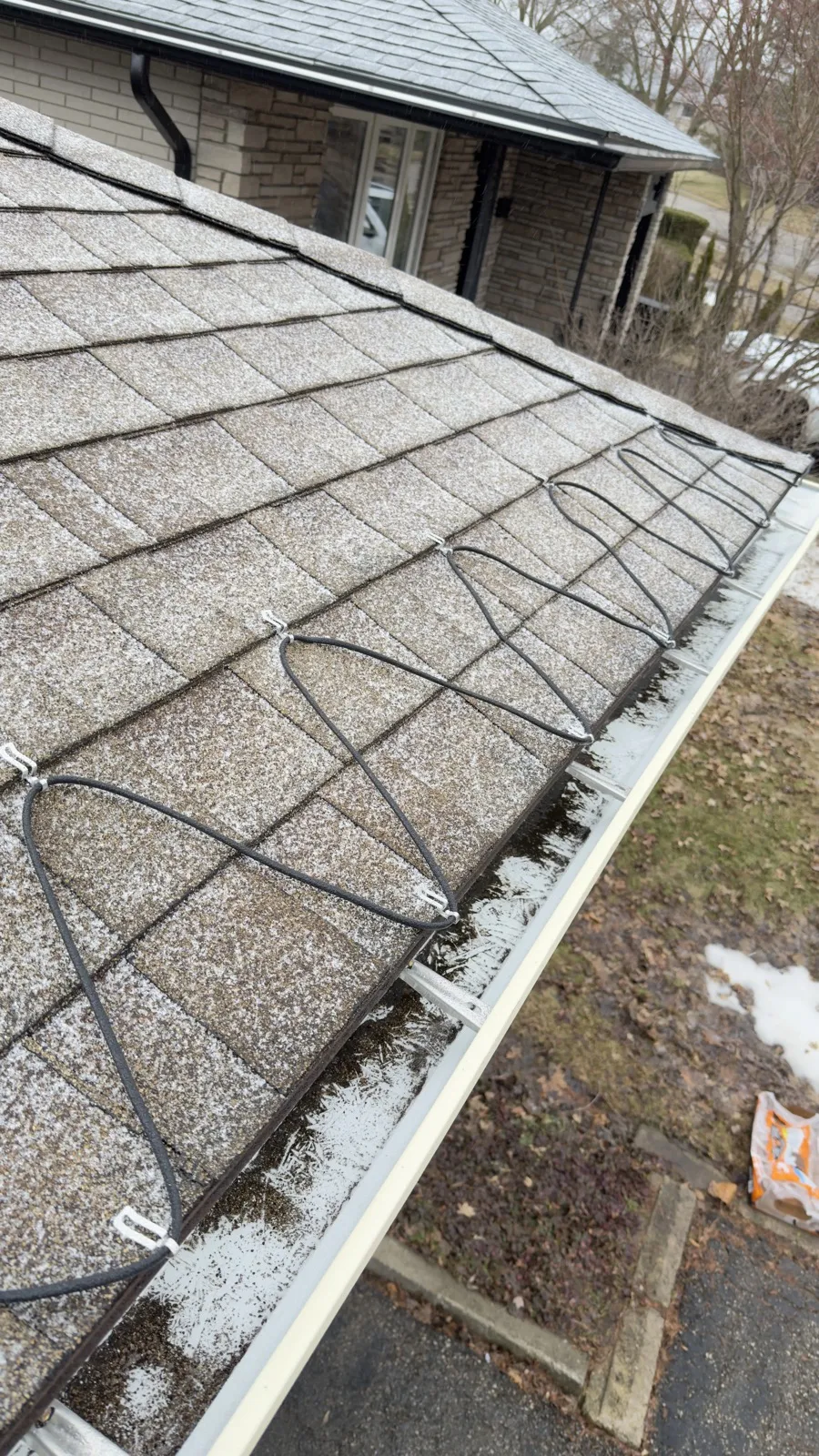
- Plan the zigzag before you buy. The clips set the spacing. If a corner makes two runs meet, change the layout.
- Do not coil spare cable. Extra length does not go in a loop on the roof. The maker says where surplus may go, if anywhere.
- Treat the manual as the rule. A maker that permits crossing for its self-regulating cable will say so and may limit where. A maker that forbids it is not wrong because another brand allows it.
- Keep cable out from under roofing unless the product is made for it, and keep leaves and debris out of the eavestrough where cable lies.
Our post on professional versus DIY heated wire systems explains why layout planning is where most home installs go wrong.
Running cost and lifespan: what actually differs
Running cost depends on watts, hours and your electricity rate. Neither type is free to run. A self-regulating cable eases off as it warms, so on a mild thaw it should draw less than a constant-wattage cable of the same rating. The bigger saver is control. A moisture and temperature sensor that starts the cable only in cold, wet weather beats the choice of cable type. Our post on energy efficiency and heated wires covers the control options. Natural Resources Canada does point out that heating cables use a significant amount of electricity, which is one reason to size them to the problem eaves.
Lifespan has no honest single number. The maker's literature and warranty state what to expect, and real life shortens or lengthens it. These matter most:
- Damage. Falling ice, ladders and sharp clips cut jackets.
- Sun and heat exposure. A cable jacket ages outdoors.
- Wet connections. Splices and end seals that let water in fail early.
- Misuse. Overlap, being left powered in summer or a poor circuit all cut a cable's life.
Our guide to how long heated wires last in the Ontario climate goes through what wears them out. In both types, a cable that looks cracked, cut or scorched has reached the end of its life, whatever its age.
Best self-regulating roof heat cable: what to look for
Brand rankings are not useful here, because the right product depends on the roof. These are the features worth checking on any self-regulating roof heat cable.
- Made for roofs and gutters. Pipe heat cable is not the same product. Check the label for your roof covering, as a cable approved for shingles may not be approved for metal.
- Certification mark. Look for a safety certification accepted in Canada, and ask the seller to confirm.
- Cut-to-length or fixed. Decide whether you want to trim to your run or buy a fixed kit, and know the end-kit parts if trimming.
- Watts per length and maximum circuit length. The maker's table gives the longest run allowed per breaker size, and it includes the cold-start surge.
- Control compatibility. Check that a sensor or thermostat is supported and how it is wired.
- Ground-fault protection requirements. The manual states what protection the circuit needs.
- Clips and accessories sized to your roof edge. Clips hold the cable in its planned layout.
The same list works for a constant-wattage cable, with the added checks that the length is exact and that your layout never crosses it.
Choosing for your eave, and who does the wiring
Choose self-regulating cable if your roof has valleys, dormers or changes in pitch, if you want to cover the eave, eavestrough and downspout with one product, or if you cannot plan a perfect layout. Choose constant-wattage cable if the run is a straight edge of known length and the layout will genuinely never cross. In both cases, spend your attention on the control and the circuit.
Power is a separate question. A plug-in system uses a protected exterior outlet. A dedicated circuit, hardwiring and controls are electrical work that the Electrical Safety Authority says should go to a Licensed Electrical Contractor, because that is the only sure way to have it done safely and legally. The estimate for a cable job should state who does the electrical part.
Also be honest about the goal. Natural Resources Canada says the preferred fix for most houses is to keep house heat out of the attic by air sealing and insulating, with cable as a way to keep drainage open where ice dams still form. Our post on attic insulation and ice dams covers the root cause. If you want the cable laid out and installed, D&D's roof and gutter heating cable service starts from a free written estimate.
Roof heat cable questions homeowners ask
What is the best self-regulating roof heat cable?
There is no single winner, because it depends on your roof. Look for cable made for roofs and gutters, with a safety mark accepted in Canada, a maximum circuit length that fits your breaker, clips for your edge and a supported control. Match the product to your roof covering, and follow the maker's layout.
Is self-regulating cable safer than constant-wattage cable?
It forgives more mistakes, since it lowers its own output where it warms and some makers allow limited crossing. It is not exempt from risk. Damaged jackets, wet connections, overloaded circuits and missing ground-fault protection are hazards for both types. Inspect from the ground each fall and replace anything cracked or cut.
How do I install self-regulating roof heating wire?
Follow the maker's layout. Typically that is a zigzag held in clips along the eave, with cable run through the eavestrough and down each downspout, ending at a power connection. A plug-in kit uses a protected outdoor outlet, while new wiring or a dedicated circuit is a job for a Licensed Electrical Contractor. Do not climb an icy roof edge.
What are the top rated roof heating cables?
Ratings online are mixed and do not reflect your roof, so this page does not rank brands. Judge any product on its approval mark, roof compatibility, circuit limits, control options and warranty terms. A cable that fits your layout and is wired correctly will do better than a high-rated one that does not.
Ready for a Reliable Winter Season?
D&D Snow Services covers Kitchener, Waterloo, Cambridge, Guelph and surrounding region.
Get a Free Snow QuoteKey Takeaways
- Self-regulating cable is the usual choice for Ontario roofs with valleys, dormers or mixed eave and gutter runs.
- Constant-wattage cable suits straight runs of known length and must never touch or cross itself.
- Overlap can melt the insulation and cause a short circuit, so plan the layout before buying.
- Control usually matters more for running cost than cable type, and neither type has one fixed lifespan.
- Wiring beyond a plug-in outlet is electrical work for a Licensed Electrical Contractor.
Sources & References
Request snow-service details
Identify the clearing areas, access priorities and seasonal or per-visit needs.
Prefer to send the details first? Request a quote or call (519) 501-5003.