Snow brakes for metal roofs are the same kind of accessory as snow guards, snow stops, snow stoppers and ice guards: parts that hold snow on the roof so it melts or slides off gradually. The real difference is the design. Individual pad guards sit in staggered rows, while snow bars and rails run in a continuous line. When you collect quotes, ask which of the two each contractor means.
Snow brakes for metal roofs: the names you will hear
Suppliers, roofers and search engines all use different words for roof snow retention. The terms overlap, and some are regional habits. Use this table as a rough translator, then ask the contractor to describe the actual product.
| Name you hear | What it usually means |
|---|---|
| Snow guard, snow brake, snow stop, snow stopper | The general category. Often a small pad-style guard, but any retention part can be called this |
| Snow breaks | A common misspelling of snow brakes. Same product |
| Ice guard, ice stop | Most often a pad-style guard, though some people use it loosely for any retention system |
| Ice cleat, snow cleat, snow clip | A small individual guard. Note that ice cleats are also traction spikes for boots, so search results can wander |
| Snow bar, snow rail, roof snow bars, snow fence | A continuous bar or tube running across the roof on brackets |
| Snow retention system | The formal term in specifications. Covers pads, rails or a mix |
The lesson is simple. A quote that says only "snow guards" or "snow stops" does not tell you whether you are getting pads or rails, how they attach or how many rows there are. Those details decide how the roof performs.
Individual pad guards: how they work
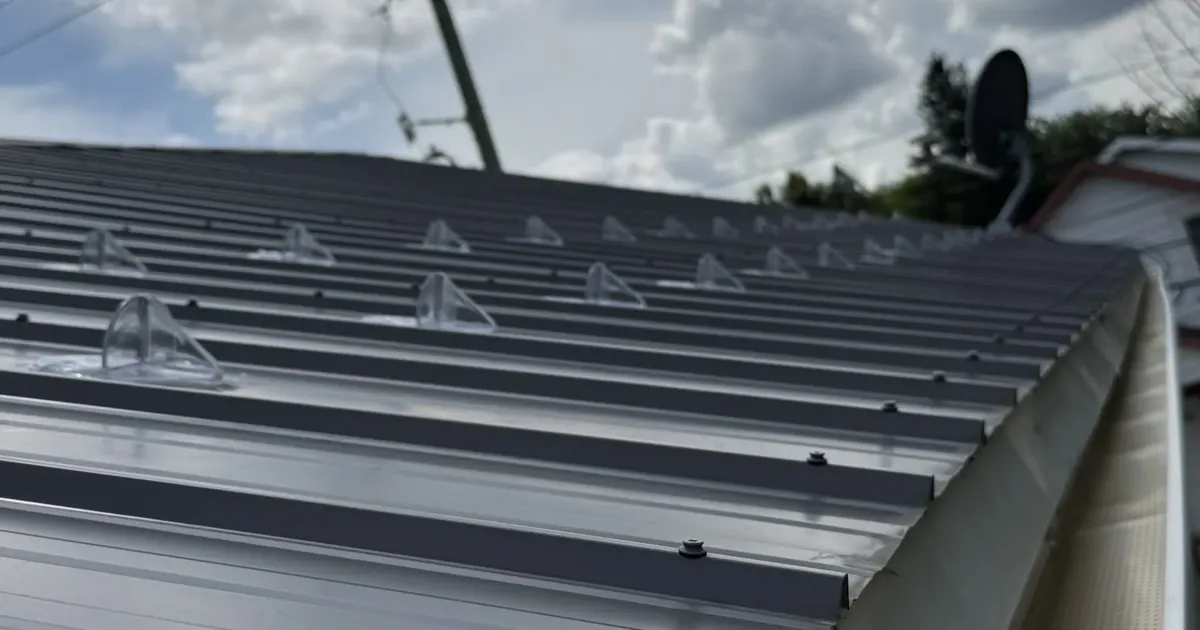
Pad-style guards are small blocks, cleats or clips fixed to the roof in a staggered grid. Each one is a point of resistance. Snow builds up against the guards and between them, which holds the layer in place and breaks it into smaller pieces as it eventually melts or slides. Meltwater runs through the gaps.
A pad system relies on several rows spread up the slope, with each guard and its attachment carrying a share of the load. That makes the layout and the quality of each attachment the key to results. A few guards set near the eave are not enough on a long slope.
Pad guards are often chosen when appearance matters, because they are low and small, and when the roof run is moderate. They suit both main metal roof types. On a standing seam roof they clamp onto the seam without holes. On exposed-fastener steel they are fastened and sealed. Our post on matching the system to the roof explains why the attachment matters as much as the guard.
Snow bars and rails: how they work
A rail system uses a bar, tube or flat strap that runs horizontally across the roof, held up on brackets or clamps spaced along its length. Because the bar is continuous, snow meets one unbroken line instead of a field of separate points, and the load is shared between all the attachments along that line.
That is why rails are often considered for long, steep slopes, areas that get deep snow, and spots where a slide would be especially hazardous, such as above a main entry or a driveway. The trade-offs are looks and installation. A rail is a visible line across the roof, although finishes can be matched to the panels. It also tends to use more material per metre of roof and take longer to fit.
Rails attach in the same two ways as pads. Standing seam roofs take clamps on the seams. Corrugated and other exposed-fastener roofs need fastened brackets sealed at each point. Neither type of rail replaces the need for a roof-specific layout. Our snow guard buyer guide for Ontario covers what a good proposal includes.
Snow guards vs snow rails: how to choose
| Factor | Individual pad guards | Continuous rails |
|---|---|---|
| Look | Small, low profile, spread in a pattern | A visible line across the roof |
| How load is carried | Each guard and attachment takes its share | The bar ties attachments together and spreads the load |
| Typical fit | Moderate roof runs where looks matter | Long, steep or heavy-snow slopes, and high-risk spots |
| What drives the quote | Number of guards, rows and attachments | Metres of rail, number of rows and brackets |
| Main thing to check | Enough rows for the slope length | Bracket spacing and attachment to the panels |
Choose pad guards if you want a low-profile look, the slope is not extreme and the installer can show enough rows for the length of the roof.
Choose rails if the slope is long or steep, you get deep snow or the area below is high-risk and you accept a visible line.
Both styles can be mixed on one building, for example rails over a main entrance and pads elsewhere. For help deciding whether any retention is needed, read why Ontario homeowners need snow guards and how they work.
What to ask a contractor to quote
Skip the nicknames and ask for details in writing. A good quote covers:
- The exact product and whether it is a pad guard or a rail, with the manufacturer's name.
- How it attaches to your panel profile: clamped to the seam, or fastened and sealed at each fixing.
- The number of rows and where they sit on the slope, ideally on a simple roof sketch.
- The areas below that the layout protects, such as entries, walkways, the driveway, decks, vents and air conditioners.
- Confirmation that the guard, fasteners and panel metals are compatible.
- The finish or colour, if matching matters to you.
- Who is responsible if a fastener leaks, and what the contractor's own work warranty says.
Timing matters too. Installation is easiest in the fall before snow arrives. D&D Snow Services plans guard layouts above entries, walkways, decks, driveways, eavestroughs, vents and air conditioning units, and the snow guard service page explains how to request a free written estimate. Guards are only part of roof snow care, so read our post on whether snow guards replace snow removal too.
Look-alike names for different products
A few roof-edge products sound similar and do different jobs. Make sure your quote is for the right one.
- Gutter guards are screens that keep leaves out of eavestroughs. They do not hold snow on the roof.
- Ice and water shield is a waterproof membrane under the roofing along the eaves. It limits leaks but does not retain snow.
- Heating cable keeps meltwater channels open at the roof edge and in eavestroughs. It does not hold snow either.
- Roof raking and snow removal are manual jobs done when needed, not a fitted part of the roof.
If a listing says "ice guard", confirm with the seller whether it means a snow retention device or one of the products above. The snow brake you want is the one that holds snow on the roof.
Snow brake and snow guard questions
Are snow brakes the same as snow guards?
In everyday use, yes. Snow brakes, snow guards, snow stops and snow stoppers all describe parts that hold snow on a roof so it releases slowly. The differences are in the design, such as pads or rails, and in how the part attaches to your particular roof.
What is the difference between snow guards and snow rails?
Snow guards usually means individual pad-style parts set in staggered rows. Snow rails or snow bars are continuous bars that run across the roof on brackets. Rails share load along a line and are more visible. Pads are low profile but depend on enough rows and secure attachment.
What are ice guards for a metal roof?
Most of the time, ice guard is another name for a pad-style snow guard. People also use it loosely for any snow retention part. Confirm the exact product with the seller. It should not be confused with ice and water membrane or with heating cable, which do different jobs.
Do snow stops damage a metal roof?
They do not have to. Clamp-on guards for standing seam panels grip the seam without holes. Fastened guards for corrugated steel do pierce the panel, so the sealing and fixing points matter. Ask the panel maker about warranty terms before work starts, and choose a trained installer.
Ready for a Reliable Winter Season?
D&D Snow Services covers Kitchener, Waterloo, Cambridge, Guelph and surrounding region.
Get a Free Snow QuoteKey Takeaways
- Snow brakes, snow stops, snow stoppers, ice guards and snow guards are mostly different names for roof snow retention.
- Pad guards sit in staggered rows, while snow bars and rails form a continuous line across the roof.
- Rails are often considered for long, steep or heavy-snow slopes, and pads suit moderate runs where looks matter.
- A quote should name the product, the attachment method, the number of rows and the areas below that it protects.
- Do not confuse snow guards with gutter guards, ice and water membrane or heating cable.
Request snow-service details
Identify the clearing areas, access priorities and seasonal or per-visit needs.
Prefer to send the details first? Request a quote or call (519) 501-5003.