Snow guards for solar panels are worth adding when snow sliding off the array could hit people, cars, entrances or a lower roof, and you cannot simply let it fall. Natural Resources Canada warns that arrays can be a hazard when large sections of snow slide off the glass. The trade-off is winter output, because anything that holds snow on the panels keeps them shaded longer.
Why snow slides off solar panels so suddenly
Solar panels are sheets of smooth glass set at a slope. Snow has almost nothing to grip. When the sun warms the dark cells, or a thaw wets the underside of the snow layer, a large section can release in one go. Natural Resources Canada says photovoltaic arrays can be a hazard when large sections of accumulated snow slide off the glazing.
Where that snow lands depends on the roof. On a shingle roof it may drop onto the roof below the array and keep moving. On a metal roof, which is also slick, snow that leaves the panels can carry on down the slope and over the eave. In both cases it can end up on a front step, a walkway, a driveway, a parked car, a deck, an air conditioner or the eavestrough of a lower roof.
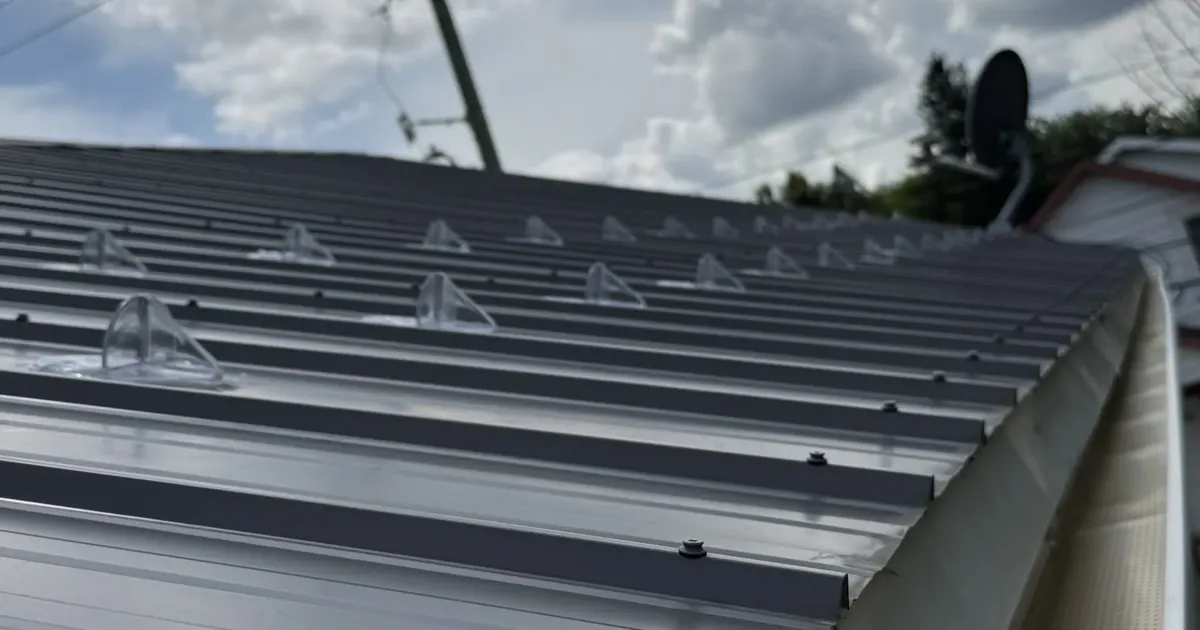
Snow guards hold snow in place so it melts or slides off more gradually. They are the same family of products covered in our post on metal roof snow retention in Ontario, but an array adds questions that a plain roof does not: output, attachment and warranties.
Do you need snow guards for solar panels? Start with what is below
The decision is mostly about the drop zone, the strip of ground and roof under the array where snow will land. Look at what sits there.
| What is below the array | Lean toward |
|---|---|
| Entry door, steps, walkway, driveway or parked cars | Guards are worth serious thought, or keep people and vehicles out of the zone |
| A lower roof, skylight, eavestrough, vent or air conditioner | Guards, plus a check that the lower roof can carry the extra snow it receives |
| A neighbour's yard, a lane or a shared path | Guards, since you cannot control who walks there |
| Open yard that nobody uses in winter | Usually let the panels shed |
| A ground-mounted array | Usually no guards. Keep the area below clear of paths, play spaces and parking |
If nothing is at risk, letting the panels clear themselves is the simpler choice. If something is, protect that part of the roof edge. Our post on whether you need snow guards on your Ontario roof walks through the same questions for roofs without panels.
Guards or letting panels shed: the output trade-off
Panels make power only when light reaches the cells. Snow that stays on the glass blocks that light until it melts or slides. Natural Resources Canada notes that arrays mounted at low angles, generally 15 degrees or less, do not shed snow as well and will not perform as well in winter as steeper ones. Guards that hold snow on the panels extend that effect.
You do not have to choose all or nothing. Three approaches sit in between:
- Protect only the sensitive stretch. Put guards above the entry or the car spot and leave the rest of the array free to shed.
- Guard the roof below, not the panels. Let the array shed normally and catch the snow lower down, where it does not shade any cells.
- Ask about shading at the lower edge. How snow sitting on the bottom row affects output depends on the panel and the wiring layout. Your solar installer can tell you.
Winter days are short in Ontario, and sunlight is low and weak in December and January, so the output lost to snow on a few days may matter less than a person or a car hit by a slab. That call is yours, and it is made easier by knowing what the drop zone holds.
Where snow guards go on a roof with solar panels
There are three common positions, and they can be combined.
- On the array. Snow clips and snow fences attach to the array to slow and break up the release of snow, according to Natural Resources Canada. It adds that these attachments are typically limited to regions with snow loads up to 2.39 kPa. Ask the solar installer what applies at your address.
- On the roof below the array. For higher snow loads, the same guidance advises planning roof space and access to the roof structure so snow fences can be mounted directly to the roof surface below the array.
- At the eave. Conventional snow guards along the roof edge catch whatever gets that far, and they protect entries, walkways and driveways below.
The roof surface decides how a guard attaches. On a standing seam roof, clamp-on guards grip the seams without puncturing the panels. On other metal roofs, fastened guards are sealed at each fastener. On shingles, the guard type and flashing are different again. Our post on snow guard materials for each roof type covers the attachment side. Installation is easiest in the fall, and a new array is a good moment to plan it, while the racking and roof are still open during the solar install.
Protecting warranties, structure and safety
Three checks apply before anything is attached near an array.
- Panel and racking warranties. Ask the manufacturers or your solar installer, in writing, whether a guard may be fixed to the frames or racking and which product they accept. Do not drill or clamp on the array without that answer.
- Roof warranty. Any new fastener through the roofing must be sealed, and clamps on standing seam avoid holes. Check the roofing warranty terms before work.
- Structure. Snow that is held in place stays on the roof as weight. The array, racking and roof must be able to carry it. Natural Resources Canada refers designers to the National Building Code structural commentaries for snow and wind loads on roof-mounted arrays. Ask the designer or an engineer to confirm, especially if you are adding guards later. Our post on roof snow load limits in Ontario explains the basics.
On safety, panels produce electricity whenever light reaches them, even under a thin layer of snow. Do not climb onto an array, and do not scrape it with a shovel or rake. The glass scratches easily and a ladder in winter is a fall risk. Keep guards and fasteners clear of conductors and conduit.
What affects snow guard cost and who to call
Searches for snow guards for solar panels cost usually want a number. No single price fits, because the job changes with:
- the length of roof edge or array edge to be covered
- the number of rows and whether you choose pads or rails
- the roof type and how the guards attach
- roof height and access
- whether the guards go in with a new solar install or onto an existing array
- coordination between the roofer and the solar installer
Ask for a written estimate that names the product, the attachment method and the area it protects. D&D Snow Services plans snow guard layouts around entries, walkways, decks, driveways, eavestroughs, vents and air conditioning units. Mention the array when you ask for a free written estimate on the snow guard installation page, so the layout can be reviewed alongside your solar installer's requirements.
Solar panel snow guard questions
What are snow guards for solar panels?
They are clips, fences, bars or guards that slow snow sliding off a solar array and break it into smaller pieces. Some attach to the array. Others mount on the roof below it or along the eave. The goal is to protect people, cars and lower roofs, not to keep the panels covered.
Will snow guards cut the output of my solar panels?
They can, because snow held on the glass blocks light longer. How much depends on the roof pitch, where the guards sit and how your panels are wired. Guards placed on the roof below the array, or only over a sensitive stretch, limit that loss. Your solar installer can advise.
Can snow guards be added to an existing solar array?
Often yes, but get approval first. Ask the panel and racking manufacturers whether a guard may attach to the frame or racking. Guards on the roof below the array avoid that question, but still need a roof-specific layout and sealed fasteners. Fall is the easiest time to schedule the work.
Should I clear snow off my solar panels myself?
It is better not to. Panels are live whenever light reaches them, glass scratches easily and a ladder or roof access in winter is dangerous. Snow often clears from panels on its own during a thaw or a sunny day. If snow slides create a hazard, solve it with guards and a clear drop zone.
Ready for a Reliable Winter Season?
D&D Snow Services covers Kitchener, Waterloo, Cambridge, Guelph and surrounding region.
Get a Free Snow QuoteKey Takeaways
- Snow can slide off solar panels in large sections, so check what sits below the array before deciding on guards.
- Guards protect people and property but hold snow on the glass longer, which reduces winter output.
- Options include clips or fences on the array, guards on the roof below it and conventional guards at the eave.
- Get panel, racking and roof warranty answers in writing, and have the designer confirm the structure can carry held snow.
- Do not scrape, rake or climb onto a snowy array. Leave roof work to trained crews.
Sources & References
Request snow-service details
Identify the clearing areas, access priorities and seasonal or per-visit needs.
Prefer to send the details first? Request a quote or call (519) 501-5003.