The right snow guards for metal roofs depend on the panel profile. Standing seam roofs take clamp-on guards that grip the seam without punching holes, while corrugated and other exposed-fastener steel needs guards screwed through the panel and sealed at every fastener. Choose the attachment first, then the guard style and layout, because the attachment decides whether the roof stays watertight.
Why metal roofs dump snow in sheets
Metal is smooth and slick, so snow has very little to grip. On a shingle roof, snow tends to break up and slide in pieces, or sit until it melts. On a metal roof, a deep layer can let go all at once, usually when the sun warms the panels or a thaw wets the underside. Heavy wet snow and freeze-thaw cycles in Southern Ontario make that sudden release common.
A sheet of snow and ice dropping from the eave lands on whatever is below: a front entry, a walkway, a driveway, a parked car, a deck, an air conditioner or the eavestrough on a lower roof. Snow guards hold the snow in place so it melts or slides off gradually instead of falling in one piece. They do not stop snow from leaving the roof. They change how fast it goes and where it breaks up.
If you are not sure a guard is needed at all, start with our post on whether you need snow guards on an Ontario roof. The rest of this page assumes you do and need to pick a style that suits the roof.
Which snow guard is best for a standing seam roof?
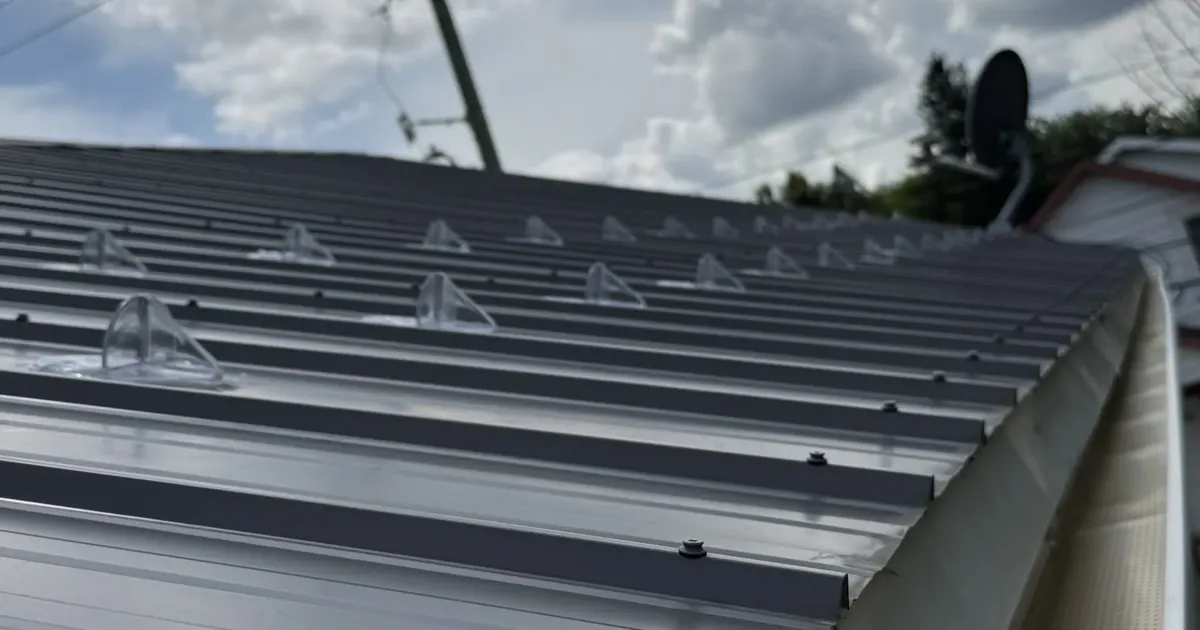
Standing seam panels have raised seams that run from eave to ridge, with the fasteners hidden underneath. That design is the reason clamp-on guards exist. A clamp grips the seam with set screws, so nothing passes through the panel. The roof stays as watertight as the manufacturer made it, and there are no new holes to seal.
Clamp-on systems come in two forms: individual guards clamped to the seams in a staggered pattern, and continuous rails clamped across several seams. Either works. What matters most is the match between clamp and seam:
- Seam profile. Seams come in different shapes and heights. A clamp made for one profile may not grip another.
- Panel metal and thickness. Different metals and gauges have different requirements. Ask the installer to confirm the clamp, screws and guard are compatible with your panel metal so that mixed metals do not corrode.
- Published holding data. Reputable clamp makers publish layout tables based on roof pitch, roof length and snow load. Ask to see the table used for your roof.
So the right guard for a standing seam roof is the one its maker lists for your seam, laid out to its tables for your roof. Our post on matching snow guard materials to the roof goes further on materials and attachments.
Corrugated, tin and steel roofs: fastened snow guards
Corrugated and ribbed steel panels, often called tin roofs even when the metal is steel, are held down by exposed screws through the face of the panel. There is no raised seam to clamp, so guards on these roofs are usually fastened. They are screwed through the panel, ideally into a purlin or the roof deck below, with sealant or a gasket at every fastener.
Some ribbed and corrugated profiles have guards shaped to sit on the rib. Ask whether one exists for your panel before you accept a plain fastened guard.
Three cautions matter on this type of roof:
- Every fastener is a possible leak. A fastened guard adds openings. The sealing method, fastener type and placement over solid support all need to be specified.
- Panel condition decides everything. Thin, rusted or loose panels will not hold a guard under a sliding load. Fix or replace weak panels first.
- Existing screws age. The rubber washers under exposed screws harden over time. Check and replace worn ones near the new guard rows while the crew is on the roof.
If you were looking for steel roof snow guards or tin roof snow guards, this is the group you are in. The question to ask is how the guard attaches, not what it is called.
Standing seam versus corrugated: side by side
| Standing seam | Corrugated or exposed-fastener | |
|---|---|---|
| How the guard attaches | Clamps onto the seam | Screwed through the panel, or onto the rib if the profile allows |
| Holes in the panel | None | Yes, sealed at each fastener |
| Main risk | Wrong clamp for the seam profile or metal | Leaks at fasteners and weak or rusted panels |
| What sets the layout | Clamp maker's tables for pitch, length and snow load | Same factors, plus where solid framing sits under the panel |
| Ask the installer | Which clamp fits my seam, and why | How each fastener is sealed and what it bites into |
Choose clamp-on guards if your roof has raised seams with concealed fasteners, you want no new penetrations and the panel maker allows seam clamps.
Choose fastened guards if your roof is corrugated, ribbed or any other exposed-fastener steel, the panels are sound and the installer can show where each fastener will land on solid support.
On either roof, you still choose between individual guards in staggered rows and a continuous rail. The layout depends on roof pitch, the length of the slope and what sits below it.
How snow guards are installed on a standing seam roof
A professional install usually follows these steps:
- Identify the panel profile, metal and thickness from the roof records or the manufacturer.
- Pull the clamp maker's layout for the roof pitch, slope length and snow load, then adjust it for the entries, walkways, decks, vents and eavestroughs below.
- Mark the rows on a dry roof, which is easiest in the fall before the first snow.
- Set each clamp on its seam and tighten the set screws to the maker's torque specification.
- Check every clamp, and look at the rows again after the first heavy snow.
This is not a good weekend project. Metal roofs are slippery, especially with frost, and falls from roofs cause serious injuries. Installers use fall protection and the right tools.
Warranty is the other reason to be careful. Before any work, ask the roof manufacturer or the original roofer in writing whether your chosen guard and attachment are acceptable. A clamp that leaves the panel untouched usually raises fewer concerns than drilling, but the panel maker's terms decide. D&D Snow Services plans guard placement by roof pitch, roof length and the area below, and the snow guard installation page shows how to ask for a free written estimate.
Metal roof snow guard questions
Can snow guards go on a standing seam roof without drilling?
Yes. Clamp-on guards grip the raised seam with set screws, so nothing is drilled through the panel. The clamp has to suit your seam profile and panel metal, and it should be laid out using the clamp maker's tables for your roof pitch, slope length and snow load.
Will snow guards void my metal roof warranty?
Not automatically, but the panel manufacturer's terms decide. Clamp-on guards avoid holes, which usually raises fewer concerns than fastened guards. Ask the manufacturer or your original roofer in writing, before installation, whether your chosen guard and attachment method are acceptable.
What are the best snow guards for corrugated metal roofs?
No single product wins. Look for a guard made for your rib shape, or a fastened guard with sealing at every fastener and fixings into solid framing. The panels must also be sound and well fixed. Ask the installer to show the layout, the fasteners and the sealing method.
When should snow guards be installed on a metal roof in Ontario?
Fall is easiest, before the first snow, when the roof is dry and access is safer. A spring check also helps, because a winter of sliding snow shows where a layout falls short. Avoid scheduling work on a frosty or snow-covered metal roof.
Ready for a Reliable Winter Season?
D&D Snow Services covers Kitchener, Waterloo, Cambridge, Guelph and surrounding region.
Get a Free Snow QuoteKey Takeaways
- Standing seam roofs take clamp-on snow guards that grip the seam without making holes in the panel.
- Corrugated and other exposed-fastener steel needs fastened guards, sealed at every fastener and set into solid framing.
- Panel profile, metal and thickness decide which guard is compatible, so the name on the box matters less.
- Layout depends on roof pitch, slope length, snow load and what sits below the eave.
- Ask the panel maker in writing about warranty before any guard goes on, and leave the roof work to a trained installer.
Request snow-service details
Identify the clearing areas, access priorities and seasonal or per-visit needs.
Prefer to send the details first? Request a quote or call (519) 501-5003.