Use roof heating cables when the temperature is near or below freezing and there is snow or meltwater on the roof, and turn them off once the roof edge stays clear and nights stay above freezing. In most Ontario winters that means a handful of cold, wet stretches, not every day from November to March.
When to use roof heating cables in an Ontario winter
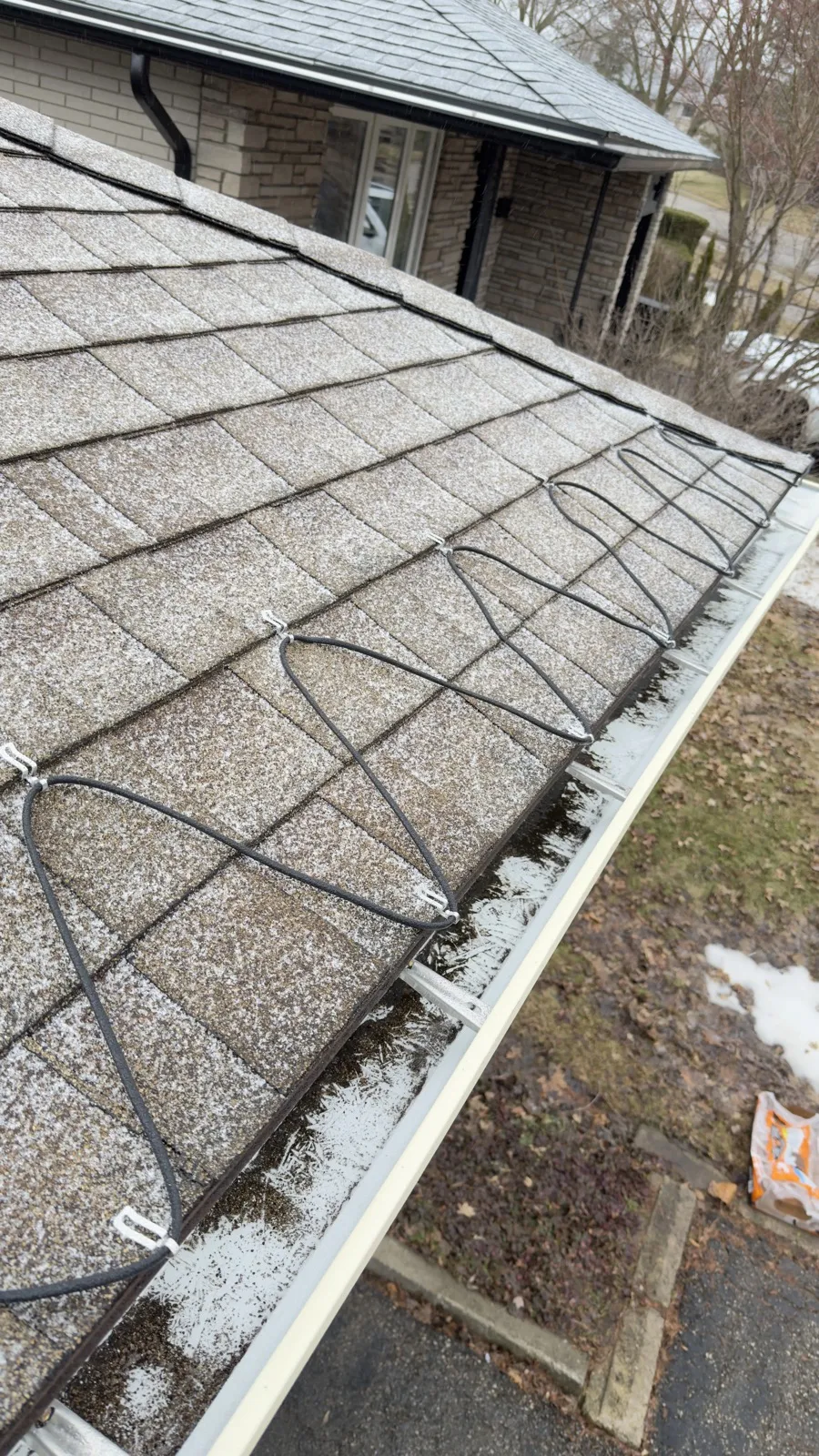
Cable has a job only when two things are true at once: it is cold, and there is water. A dry cold snap with no snow gives it nothing to do. A deep freeze with snow locked solid gives it very little. The trouble starts when the weather swings. Sun or a mild afternoon melts the snow on the roof, the meltwater runs to the cold eave, and it refreezes there. Freeze-thaw cycles, heavy wet snow and freezing rain make that pattern common in Waterloo Region and the rest of Southern Ontario.
So switch the cable on when:
- snow is on the roof, or freezing rain is forecast, and
- temperatures are hovering around freezing or are about to drop, with melting expected, or
- this particular eave, eavestrough or downspout has frozen up before.
Timing matters because cable keeps a drainage path open. It does not melt the whole roof. Natural Resources Canada notes that cables melt channels in ice that has already formed, which is slow work. Cable that is already warm when the meltwater arrives has far more chance of keeping the path clear than cable switched on after the ice is built.
How long should roof heating cables be left on?
Run them for as long as water can freeze, and no longer. In practice that is the storm and the melt that follows, until the eave drains freely and the temperature has climbed clear of freezing. It is not the whole season.
Two reasons to avoid running them nonstop. Power is the first: Natural Resources Canada says heating cables use a significant amount of electrical energy. Wear is the second, because every hour of running counts against the cable. Check your manual for any limit on continuous running and for warnings about warm weather.
A rough guide for a typical winter week:
- Heavy snowfall forecast: on before it starts, off after the roof edge has drained and the thaw is done.
- Mild spell above freezing, no snow on the roof: off.
- Dry cold snap, no snow: off, unless a downspout is still holding ice.
- Freezing rain: on, since the water arrives already liquid and freezes on contact.
Switches, thermostats and snow sensors: how control changes run time
How the cable is controlled decides how long it runs far more than the calendar does.
| Control | How it decides | What to watch for |
|---|---|---|
| Plug or manual switch | You do | Forgetting to switch on before a storm, or off afterward |
| Timer | The clock | Runs on dry days and misses a storm outside its hours |
| Thermostat only | Air temperature | Runs through dry cold with nothing to melt |
| Temperature plus moisture sensor | Needs cold and wet together | The sensor must sit where it sees the same snow and meltwater as the eave, and stay clear of debris |
A sensor control is the one that cuts waste. It starts the cable when conditions are right and stops it when they are not. Some controllers let you set the turn-on temperature, so check the range on yours.
Self-regulating cable adjusts its own heat output as it warms or cools, which is not the same as switching off. It still draws some power while it is energized, so it still needs a sensible control. Hardwired controls and the wiring behind them are electrical work for a Licensed Electrical Contractor under ESA rules.
A fall start-up routine before the first snow
- Clear the eavestroughs and downspouts. Leaves hold water against the cable and block the path it is meant to keep open.
- Look from the ground. Check that cable is still in its clips, not sagging, and that there are no cracks, cuts or bare spots. Do not climb to the roof edge on a ladder to inspect it. If something looks wrong, have it looked at.
- Test the outlet. The Electrical Safety Authority recommends ground fault circuit interrupters on outdoor outlets, with weatherproof covers. Press the test button, confirm it trips, then reset it.
- Check that the cable warms. Follow the manual's test steps. If it does not seem to heat at all on a freezing morning, switch it off and have it checked. Do not open or repair it yourself.
- Set and clean the control. Check the thermostat or sensor setting and clear the sensor of leaves and dirt.
- Be ready before the first snowfall, which in Southern Ontario can arrive before you expect it.
Our post on maintaining heated wires after installation has more on yearly upkeep.
A spring shut-down routine
Switch the cable off when nights stay above freezing and the roof edge drains without help. Do not do it on the first mild day. Ontario can drop a heavy wet snowfall late in the season, and a freeze-thaw swing in March or April can still start an ice dam.
- Switch off at the control and unplug a plug-in cable at the outlet.
- Clean the eavestroughs and downspouts again.
- Look over the cable from the ground for damage and note anything to repair before the next fall.
- Leave a reminder tag at the outlet or panel so the system is not forgotten until the following winter.
Leaving a system energized through summer wastes power and can wear it out. Our post on the spring transition after a heated wire season covers the rest of the changeover.
Timing mistakes that cause trouble
- Switching on after the ice is built. By then water may already be backing up under the shingles. Cable alone will not clear an established ice dam. That job calls for low-pressure steam, which is what ice dam removal uses, not hammering or chipping.
- Running through dry cold. It costs power and does nothing.
- Treating cable as the cure. Natural Resources Canada puts sealing attic air leaks and insulating thoroughly first for ice dam prevention. Cable manages the symptom. See our post on attic insulation and ice dams.
- Using an extension cord. If one is ever allowed, it must be rated for outdoor use and plugged into a GFCI outlet, and your manual may not allow one at all.
- Burying the sensor. A moisture sensor under a drift or a pile of leaves will not see the weather.
If your cable is not keeping up, or you want a system sized for the problem eaves, D&D Snow Services installs roof and gutter heating cable. The electrical connection is a job for a Licensed Electrical Contractor, and the estimate states who handles that part.
Roof heating cable timing questions
When should I plug in heat tape?
Plug it in before snow or freezing rain arrives, once temperatures are near or below freezing. Cable that is already warm gives meltwater a clear path. Cable switched on after ice forms only melts channels slowly. If you use a sensor control, it decides this for you.
Should I unplug heat tape in summer?
Yes. Once nights stay above freezing in spring, switch off and unplug it. A powered cable in warm weather wastes electricity, and your manual may warn against running it. Check the cable in fall before plugging it in again.
How long can you leave roof heating cables on?
Only your manual gives a firm limit, so read it. As a working rule, run them through a storm and the melt that follows, then switch off. Leaving cable energized all winter uses a significant amount of power, and most winters do not need it.
Does heat tape stay on all the time?
A plug-in cable with no control stays on whenever it is plugged into a live outlet. One with a thermostat or snow sensor runs only when its conditions are met. Self-regulating cable lowers its output as it warms, but it still draws some power.
Ready for a Reliable Winter Season?
D&D Snow Services covers Kitchener, Waterloo, Cambridge, Guelph and surrounding region.
Get a Free Snow QuoteKey Takeaways
- Use roof heating cables when it is near or below freezing and snow or meltwater is on the roof or eave.
- Switch on before the storm. Cable only slowly melts channels in ice that has already formed.
- Run them for the storm and the melt, not all winter. A temperature plus moisture sensor shortens run time most.
- In fall, clear the eavestroughs, inspect from the ground and test the GFCI. In spring, switch off and unplug.
- Cable does not replace air sealing and attic insulation, and it will not clear an established ice dam.
Sources & References
Request snow-service details
Identify the clearing areas, access priorities and seasonal or per-visit needs.
Prefer to send the details first? Request a quote or call (519) 501-5003.